

Liquidity against personal gold ornaments and assets still continues to be recognized as one of the smartest and safest ways to navigate immediate financial crunches. When faced with unexpected monetary urgency, millions of homes leverage their gold holdings without liquidating them, well aware of the fact that loans against gold assets provide quick disbursals and minimal administrative friction points. However, a critical financial tipping point is ultimately encountered when an existing repayment period reaches its completion and the principal borrowed amount cannot be settled as a one-time settlement.
At this juncture, critical decisions must be made with respect to whether a gold loan renewal is the right choice, or a fresh line of credit must be pursued instead. Prominent and well-known financial institutions and non-banking financial companies (NBFCs) such as Indel Money offer their customers with systematically structured, thoughtfully curated financial options for both options, making sure that customers get the privilege to access maximum financial flexibility according to their current monetary situation, financial requirements and their repayment capacities.
In this blog, Indel Money, the best gold loan company in India, explains the differences between an existing gold loan and new gold loan, and which option makes more sense, and the different factors to consider before zeroing in on a final decision.
Extending the repayment tenure of a gold loan involves updating the renewing the formal agreement with the lender after settling the accumulated interest up to that particular point. This operational framework allows customers to maintain their continuous association with the financial institution without undergoing the process of a comprehensive and exhaustive reassessment cycle from the ground up. The pledged gold ornaments and other gold assets will remain safely locked within institutional high-security vaults and uninterrupted continuity is maintained throughout the entire process. Gold loan renewals are frequently prioritized by customers when access to short term funds are temporarily stonewalled to unexpected turn of events, and due to streamlined procedures with reduced bureaucratic hindrances and regulatory red tape.
Moreover, since the administrative foundation has already been put in place during the process of the initial loan disbursal, customers do not have to spend an entire day inside a branch to get their loan approved and processed. Borrowers can effortlessly proceed along their financial trajectory without being subjected to the tedious and time consuming process of opening a brand new account, making it an efficient and optimal choice for continuous credit management.
On the other hand, commencing a new gold-backed financial arrangement involves formally pulling the plug on the pre-existing credit account, releasing the collateralized gold ornaments into the hands of the borrower for a temporary period of time, and then quickly re-encumbering the same gold assets to gain access to a fresh pool of funds. As a matter of fact, this option becomes exceptionally beneficial if the gold prices have significantly appreciated from the time of the initial borrowing date. Because in international and domestic markets gold prices undergo constant fluctuations, a higher current valuation standard will allow bigger disbursement against the same amount of gold.
Borrowers who are actively looking for strategies to maximize their working capital and elevate financial ambitions such as enterprise expansion, pursuing higher education or personal goals, commonly go for a fresh loan application. Furthermore, capitalizing on a new loan allows the borrower to bargain or procure special financing rates, revised and restructured loan-to-value (LTV) limits and renewed repayment structures that probably did not come into existence when the original disbursal was initiated and approved months, or maybe even years ago.
A lot of business and economic variables clearly highlight the fundamentals differences between both the choices. The borrower must consider every angle and think deeply, carefully and analytically before actually making the final decision. A gold loan renewal is predominantly marked by extraordinary speed, significantly minimal verification and documentation processes and the direct protection of already existing rules and regulations. It cuts down time consuming paperwork and effectively obstructs the organizational streamlining protocols that are required to be followed while onboarding a new customer.
On the other hand, initiating a fresh gold loan opens doors to a plethora of advantageous prospects for renewed loan-to-value limits, revised interest rates and customized tenure options carefully curated to align with the consistently evolving economic realities. But, borrowers must also consider regulatory fees, processing charges and new assessment costs may apply differently when you are initiating a brand new loan file when compared to just extending the one that already exists. Analyzing these financial implications and trade-offs against the monetary prospects of a bigger loan amount is crucial when it comes to making an economically valid decision.
Maneuvering sophisticated credit assessments requires the support of a credible and established financial institution that is capable of providing informed mentorship and secure capital management. Indel Money is a trusted gold loan provider and an established non-banking financial company (NBFC) that prioritizes on offering customer focused monetary solutions that are designed to enable and empower people from all walks of life. Clear assessment protocols, competitive and customer friendly interest rates, and top-tier secure gold loan facility that make sure that every single gram of pledged gold is preserved and protected with great care and responsibility.
Be it a smooth and seamless tenure extension or a rigorously formulated fresh loan agreement, Indel Money is committed to offering its customers the right professional support anytime, anywhere. Our team is equipped with expert financial advisors that collaborate closely with our customers to evaluate changing market performance and elevate personal monetary stability, making sure that every customer picks the course that genuinely maximizes their financial standing.
At the end of the day, choosing between a gold loan renewal and a new gold loan entirely depends on the individual's monetary goals, quick financial requirements and existing gold prices. Renewals are best for individuals looking to harness financial liquidity with maximum convenience, minimal administrative delays and uncomplicated tenure extensions.
Conversely, new gold loans are apt for people looking to access higher principal amounts marked by the positive appreciation of gold assets in the local and global markets. By comprehensively analyzing personal repayment capacities along with solid commercial solutions and top-tier professional guidance offered by reputable financial institutions like Indel Money, customers can boost financial stability, uninterrupted asset protection and long-term peace of mind. Making an informed decision today shields your financial future from unexpected shocks while your valuable gold assets do the heavy lifting to fulfill your needs.
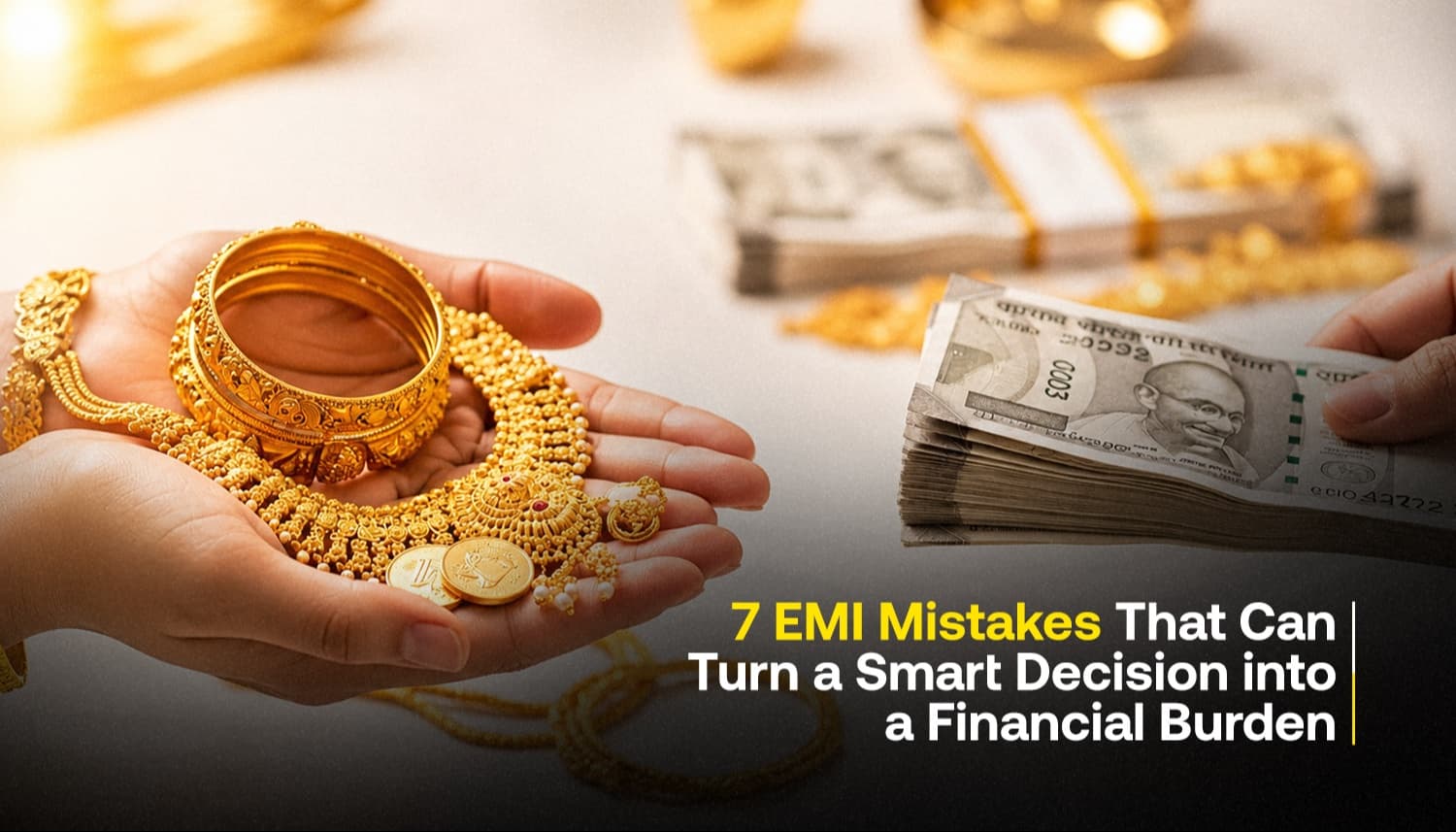
EMIs are the best way to make big loans feel easy. But this easy solution can become a headache if you don't have a clear financial plan.
Lakhs of people across India take gold loans every day for big purchases or emergency spending. The monthly installment feels manageable, but somewhere along the way, small mistakes turn this into a financial nightmare.
The good news is that these mistakes are entirely avoidable.
This is the most common one. A lender shows you a monthly installment that seems affordable, and you say yes.
But the EMI is just one number. What actually matters is the total amount you'll pay over the full tenure. Including the principal, interest, and processing fees.
A loan of ₹50,000 for two years with an interest rate of 18% costs more than a shorter loan period. When you choose to pay a lower EMI, you end up paying a lot more in the long run.
Always check the total amount that needs to be paid before opting for an EMI, as the monthly payments do not represent the total cost of the purchase.
If you think stretching your tenure to make the monthly EMI easy, you are wrong. In most cases, it isn't worth it.
As the tenure extends, you will have to pay more interest. Even at the same interest rate, a 3-year tenure costs significantly more than a 1-year tenure.
If you can, choose the shortest tenure you can manage based on your income.
One missed payment feels minor. The consequences aren't.
Missing an EMI directly hits your CIBIL credit score. When your credit score takes a hit, it becomes harder for you to secure future loans. You might also get burdened with higher interest rates because lenders may see you as a high-risk borrower.
On top of that, banks charge late payment penalties, and your outstanding balance can increase significantly.
Set up an auto-debit instruction from your bank account. Schedule it for the day after your salary credit. That one step removes the risk entirely.
This one is small but surprisingly common.
If your monthly paycheck hits your account after your EMI auto-debit, your account may have insufficient funds. As a result, your EMI payment will be considered missed, and your account may be charged a late payment penalty, bank charges, and a missed payment fee.
When you take a loan, choose an EMI date 3 to 5 days after your salary credit date. That buffer matters.
Many borrowers focus entirely on the interest rate and ignore everything else in the loan agreement.
But lenders can charge fees like processing fees, prepayment penalties, foreclosure charges, and bounce charges for failed auto-debits. These can add up to a meaningful amount over the loan tenure.
Before signing anything, ask for a complete breakdown of all charges. A regulated loan company in India will provide this upfront and clearly.
A single EMI is manageable. Three or four running simultaneously is where people run into trouble.
Financial planners generally recommend keeping your total EMI outgo below 40% of your monthly income. So if you earn ₹40,000 a month, your total EMIs across all loans should ideally stay under ₹16,000.
Many finance companies in India make it easy to split purchases into installments. That's convenient, but it adds up fast. A phone on EMI, a TV on EMI, and a personal loan EMI can quietly eat up most of your monthly income before you've paid rent or groceries.
Before taking a new loan, add up what you're already paying each month. Make sure there's room for the new EMI and your other expenses.
If you come into extra money, paying off part of your loan early is one of the smartest things you can do.
Prepayment reduces your outstanding principal. That means less interest is calculated on the remaining balance, and you can either lower your EMI or shorten the remaining tenure. Both outcomes save you money.
Some lenders charge a prepayment fee. Be sure to review this before you sign the loan agreement. There are several gold loan nbfc in India that charge little or no prepayment fee, and it is important to shop around before finalising the terms of your gold loan.
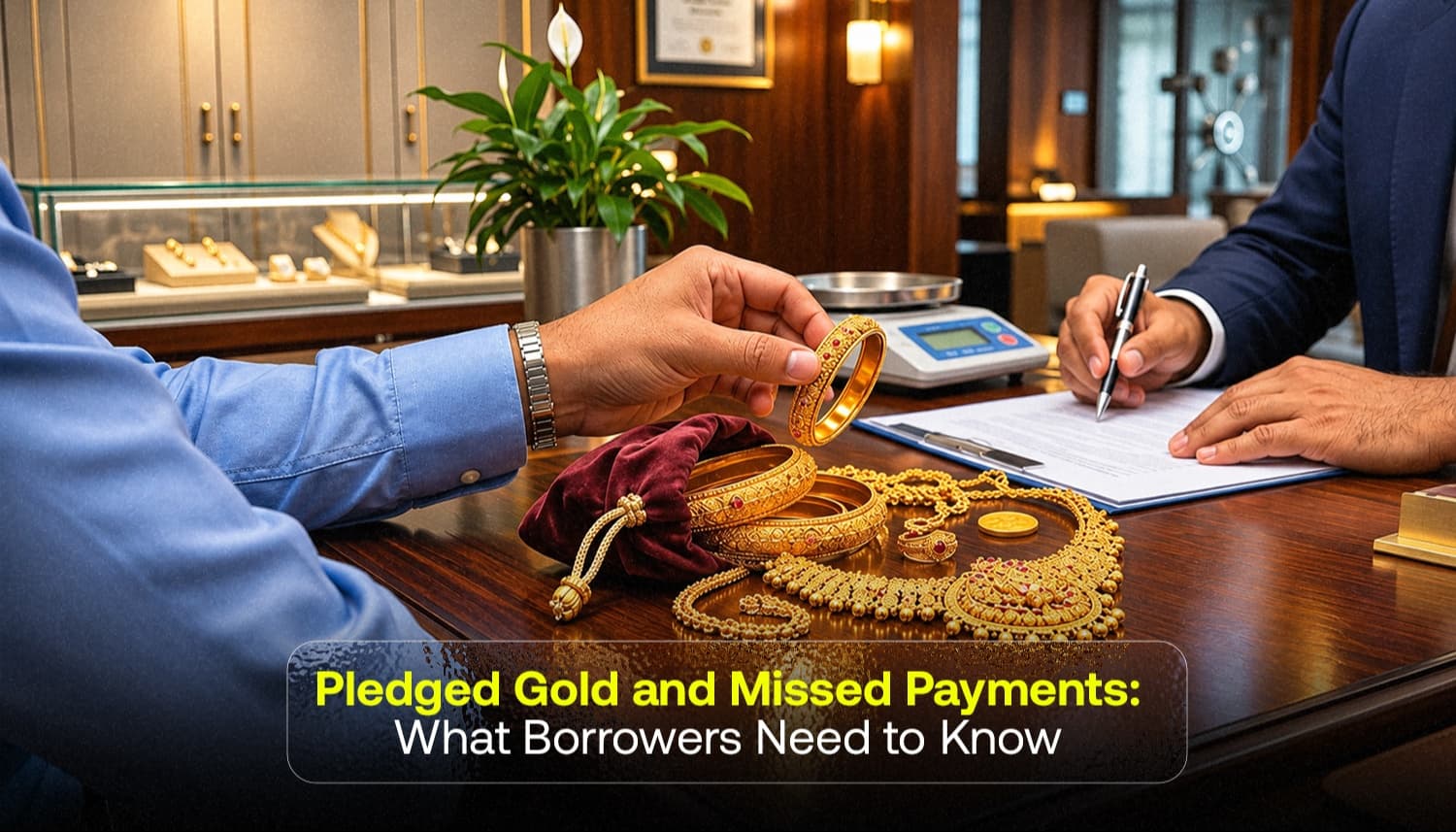
Missing a gold loan payment is stressful. But it doesn't mean you've lost your gold.
Gold loans in India are one of the easiest ways to get credit. You give your jewelry, get money promptly, and repay it over a set period.
Fortunately, the Reserve Bank of India has set rules to protect you at every step. The lender can't just take your pledged gold without proper notice and process.
In case you default on the gold loan, the lender will call you up and remind you to pay. Your lender will only put your gold up for auction after your account becomes a Non-Performing Asset (NPA) after 90 days of non-payment. Even so, they must give advance notice before any auction, and they'll return any surplus from the sale to you. |
One missed payment won’t trigger an auction.
Your lender will typically contact you by phone, SMS, or mail if you miss an EMI. A late payment fee and extra interest starting on the default date will be applied to late payments. Your credit score could also suffer if the lender reports the missed payment to a credit bureau.
Auction arises only if the account remains unpaid for over 90 days. If you don't repay the loan by then, it becomes a Non-Performing Asset (NPA).
So if you've missed one payment, the priority is simple: contact your lender immediately. Most trusted gold loan providers will work with you on a repayment plan before things escalate.
A lender can only auction pledged gold after following a regulated process defined by the RBI. The Reserve Bank of India has laid down guidelines that no auction can occur without proper notice to the borrower.
The process is usually as follows:
Once your account is classified as an NPA, the lender issues a formal demand notice.
The lender announces the auction in advance, stating the date, time, and outstanding amount.
This notice should give you a final chance to repay and recover your gold.
The minimum reserve price is 90% of the market price (if the auction is to be held).
Any auction proceeds that exceed the loan amount, interest, and charges will be returned to you within 7 working days.
Your gold remains your property until the auction is legally completed. Lenders cannot sell it quietly or without following this process.
The RBI has tightened gold loan regulations significantly to protect borrowers. These rules apply to all banks and gold loan NBFCs in India.
Key changes that affect borrowers include:
Loan-to-Value (LTV) ratios are now tiered. The lender can provide up to an 85% loan for gold loans of Rs 2.5 lakh and below. For loans ranging from Rs 2.5 lakh to Rs 5 lakh, the limit is 80%. For loans exceeding Rs 5 lakh, the limit is 75%.
To value gold, use the average price of 22-carat gold over the last 30 working days, as quoted by the India Bullion and Jewelers Association. This prevents arbitrary overvaluation.
Lenders should return the gold within 7 days of loan closure.
The valuation procedures, terms, and auction rules should be specified in detail in the contract in the borrower's language.
The rules are applicable to both bank loans and gold loans from NBFCs in India. As reported by Business Standard, the RBI introduced these tighter norms to bring more discipline and transparency to the sector.
There are more options than most borrowers realise.
The key is to act early! Let your lender know you may struggle to make your payment. RBI-regulated, trusted lenders can help people in temporary difficulty.
The following are some options that can be considered:
Partial payment: To prevent escalation and show good faith, partial payments can be made.
Loan restructuring: Trusted lenders may allow you to restructure the payment terms if your financial conditions are not favorable.
Interest-only payment: Interest-only payments can be made for some gold loans before starting to pay the principal.
Gold top-up/re-pledge: If the value of your gold has risen, you may be able to restructure the borrowing terms to allow longer grace periods.
The one element that always exacerbates the issue is waiting and hoping it will get better on its own. Missed payments compound and interest accumulates. And the window to act before an auction narrows.