
In a world where financial flexibility is key, gold loans have become the go-to solution for individuals seeking quick, secure, and hassle-free funding. Among the many financial institutions offering this service, Non-Banking Financial Companies (NBFCs) like Indel Money have carved a niche by combining trust, transparency, and convenience. Smart borrowers today understand that choosing the right lender makes all the difference, and that’s why many prefer NBFC gold loans, for their flexibility, personalized service, and speed.
A gold loan is one of the simplest ways to access funds. You pledge your gold ornaments or coins as collateral and receive a loan amount based on the value of your gold. Unlike traditional loans, gold loans require minimal documentation and are disbursed almost instantly. NBFCs such as Indel Money have refined this process, offering a smoother, faster, and more customer-centric experience compared to conventional banking institutions.
NBFCs have emerged as a preferred financial partner for millions of Indians. Their flexible operations, customer-first approach, and quick turnaround times make them ideal for short-term financial needs. Indel Money, with its deep roots in India’s financial ecosystem, stands out as one of the most trusted NBFCs in the sector. Built on principles of transparency and reliability, it offers financial products that align with the needs of modern borrowers.
One of the biggest reasons borrowers prefer NBFC gold loans is the unmatched speed of processing. Traditional banks often involve layers of verification, extensive paperwork, and longer approval times. In contrast, NBFCs like Indel Money provide instant gold loan approvals, often within minutes. With digitized processes and minimal formalities, customers can walk in with their gold and walk out with cash or credit in no time.
This speed is not just about convenience; it’s about meeting real financial needs on time, whether for medical emergencies, education fees, business expansion, or family functions.
Smart borrowers know that flexibility in repayment can be just as important as loan approval speed. NBFCs understand this well. Indel Money offers multiple repayment options, allowing borrowers to choose plans that best suit their cash flow and financial situation. Whether through interest-only EMIs, bullet payments, or flexible tenure options, the borrower retains complete control over repayment.
NBFCs are known for providing a higher loan-to-value ratio compared to traditional banks. This means borrowers can get more money against the same quantity of gold. Indel Money’s policies are designed to ensure that customers receive maximum value for their pledged gold while maintaining safety and transparency.
One of the key reasons why borrowers prefer NBFC gold loans like Indel Money is the ease of application. Gone are the days of lengthy forms and multiple proofs. With Indel Money, customers only need basic identification and address documents. The process is quick, and verification happens instantly, ensuring a seamless borrowing experience.
Gold holds both emotional and monetary value. Indel Money understands this deeply and ensures complete safety of the pledged gold through advanced security measures and vaulting systems. Every step of the transaction is transparent from valuation to loan disbursement to repayment. Borrowers are kept informed, and the gold remains insured until it is returned.
While speed and convenience are major draws, interest rates remain a critical factor for borrowers. Indel Money offers competitive interest rates that are designed to make gold loans accessible to all segments of society. What sets it apart is its personalized service, customers are treated not just as loan applicants, but as long-term partners. The staff ensures that each borrower fully understands the terms, interest structure, and repayment process before signing.
Today’s borrowers prefer digital convenience, and Indel Money has embraced technology to meet these expectations. Through online platforms and mobile access, borrowers can apply for loans, check loan status, make payments, and even renew loans without visiting a branch. This combination of traditional trust and modern technology makes NBFCs like Indel Money the ideal choice for today’s generation.
Gold loans are not just for emergencies. Increasingly, they are seen as a strategic tool for short-term liquidity management. Business owners use them to meet working capital needs, professionals use them to bridge short-term gaps, and families use them to fund education or personal goals. Since the gold remains safe and ownership is retained, it’s a way to unlock value without selling assets.
Smart borrowers don’t just look for money; they look for reliability, respect, and reassurance. Indel Money embodies all three. Its customer-first policies, transparent dealings, and efficient loan processing have earned it the trust of thousands across India. As one of the leading names among non-banking financial companies in India, Indel Money continues to redefine the way gold loans are perceived and delivered.
It’s not just about borrowing; it’s about partnering with an institution that values your time, understands your needs, and treats your assets with the care they deserve.
Gold loans remain one of the most dependable and efficient financial instruments available today. But where you borrow from makes all the difference. Smart borrowers prefer NBFC gold loans like those from Indel Money for their speed, flexibility, and customer-first service. Whether it’s for a short-term need or a planned financial goal, Indel Money ensures that your experience remains seamless, transparent, and rewarding, helping you meet life’s moments with confidence.
With a legacy built on trust and innovation, Indel Money stands as a symbol of how modern NBFCs are redefining financial empowerment across India.
EMIs are the best way to make big loans feel easy. But this easy solution can become a headache if you don't have a clear financial plan.
Lakhs of people across India take gold loans every day for big purchases or emergency spending. The monthly installment feels manageable, but somewhere along the way, small mistakes turn this into a financial nightmare.
The good news is that these mistakes are entirely avoidable.
This is the most common one. A lender shows you a monthly installment that seems affordable, and you say yes.
But the EMI is just one number. What actually matters is the total amount you'll pay over the full tenure. Including the principal, interest, and processing fees.
A loan of ₹50,000 for two years with an interest rate of 18% costs more than a shorter loan period. When you choose to pay a lower EMI, you end up paying a lot more in the long run.
Always check the total amount that needs to be paid before opting for an EMI, as the monthly payments do not represent the total cost of the purchase.
If you think stretching your tenure to make the monthly EMI easy, you are wrong. In most cases, it isn't worth it.
As the tenure extends, you will have to pay more interest. Even at the same interest rate, a 3-year tenure costs significantly more than a 1-year tenure.
If you can, choose the shortest tenure you can manage based on your income.
One missed payment feels minor. The consequences aren't.
Missing an EMI directly hits your CIBIL credit score. When your credit score takes a hit, it becomes harder for you to secure future loans. You might also get burdened with higher interest rates because lenders may see you as a high-risk borrower.
On top of that, banks charge late payment penalties, and your outstanding balance can increase significantly.
Set up an auto-debit instruction from your bank account. Schedule it for the day after your salary credit. That one step removes the risk entirely.
This one is small but surprisingly common.
If your monthly paycheck hits your account after your EMI auto-debit, your account may have insufficient funds. As a result, your EMI payment will be considered missed, and your account may be charged a late payment penalty, bank charges, and a missed payment fee.
When you take a loan, choose an EMI date 3 to 5 days after your salary credit date. That buffer matters.
Many borrowers focus entirely on the interest rate and ignore everything else in the loan agreement.
But lenders can charge fees like processing fees, prepayment penalties, foreclosure charges, and bounce charges for failed auto-debits. These can add up to a meaningful amount over the loan tenure.
Before signing anything, ask for a complete breakdown of all charges. A regulated loan company in India will provide this upfront and clearly.
A single EMI is manageable. Three or four running simultaneously is where people run into trouble.
Financial planners generally recommend keeping your total EMI outgo below 40% of your monthly income. So if you earn ₹40,000 a month, your total EMIs across all loans should ideally stay under ₹16,000.
Many finance companies in India make it easy to split purchases into installments. That's convenient, but it adds up fast. A phone on EMI, a TV on EMI, and a personal loan EMI can quietly eat up most of your monthly income before you've paid rent or groceries.
Before taking a new loan, add up what you're already paying each month. Make sure there's room for the new EMI and your other expenses.
If you come into extra money, paying off part of your loan early is one of the smartest things you can do.
Prepayment reduces your outstanding principal. That means less interest is calculated on the remaining balance, and you can either lower your EMI or shorten the remaining tenure. Both outcomes save you money.
Some lenders charge a prepayment fee. Be sure to review this before you sign the loan agreement. There are several gold loan nbfc in India that charge little or no prepayment fee, and it is important to shop around before finalising the terms of your gold loan.
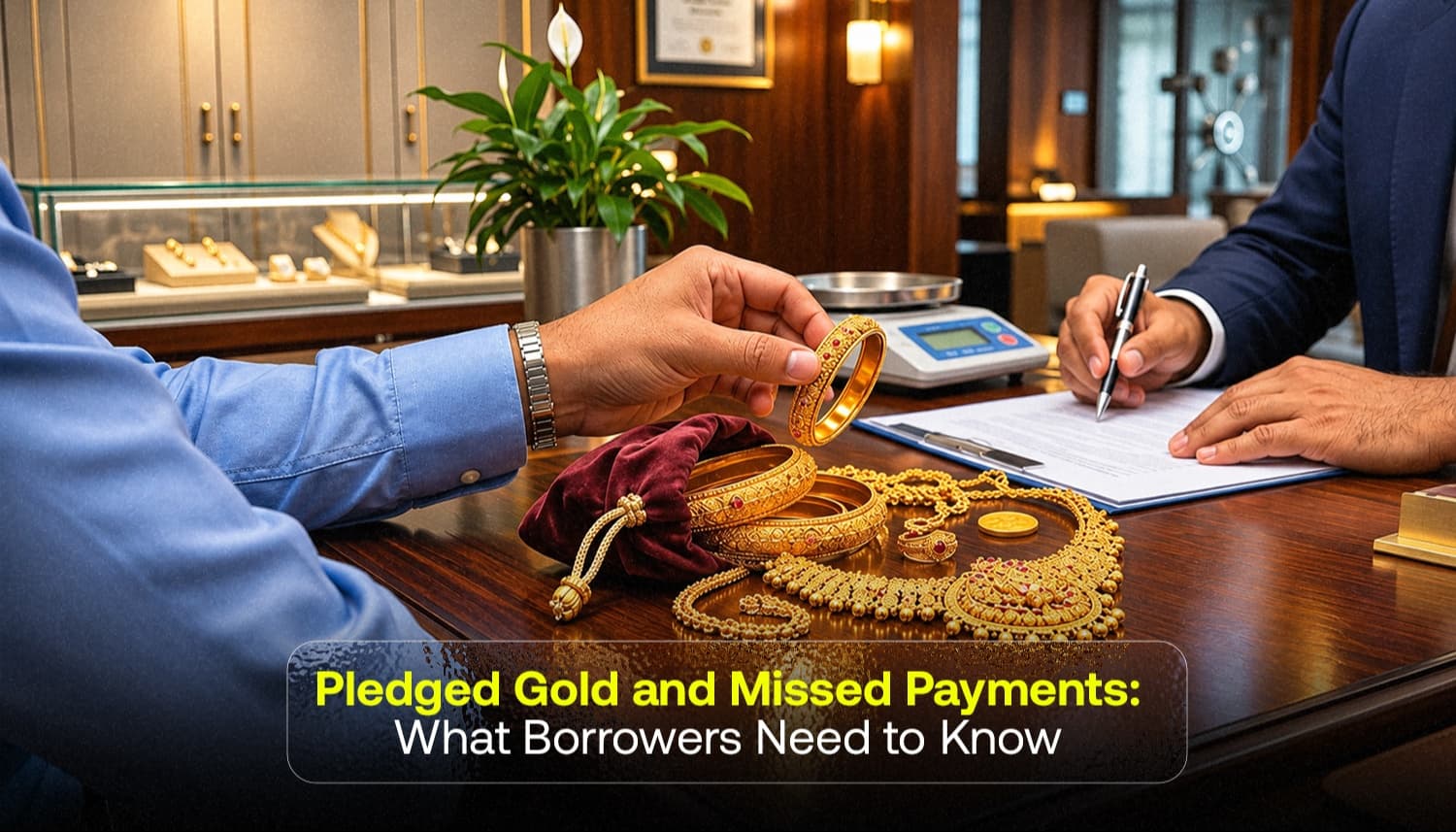
Missing a gold loan payment is stressful. But it doesn't mean you've lost your gold.
Gold loans in India are one of the easiest ways to get credit. You give your jewelry, get money promptly, and repay it over a set period.
Fortunately, the Reserve Bank of India has set rules to protect you at every step. The lender can't just take your pledged gold without proper notice and process.
In case you default on the gold loan, the lender will call you up and remind you to pay. Your lender will only put your gold up for auction after your account becomes a Non-Performing Asset (NPA) after 90 days of non-payment. Even so, they must give advance notice before any auction, and they'll return any surplus from the sale to you. |
One missed payment won’t trigger an auction.
Your lender will typically contact you by phone, SMS, or mail if you miss an EMI. A late payment fee and extra interest starting on the default date will be applied to late payments. Your credit score could also suffer if the lender reports the missed payment to a credit bureau.
Auction arises only if the account remains unpaid for over 90 days. If you don't repay the loan by then, it becomes a Non-Performing Asset (NPA).
So if you've missed one payment, the priority is simple: contact your lender immediately. Most trusted gold loan providers will work with you on a repayment plan before things escalate.
A lender can only auction pledged gold after following a regulated process defined by the RBI. The Reserve Bank of India has laid down guidelines that no auction can occur without proper notice to the borrower.
The process is usually as follows:
Once your account is classified as an NPA, the lender issues a formal demand notice.
The lender announces the auction in advance, stating the date, time, and outstanding amount.
This notice should give you a final chance to repay and recover your gold.
The minimum reserve price is 90% of the market price (if the auction is to be held).
Any auction proceeds that exceed the loan amount, interest, and charges will be returned to you within 7 working days.
Your gold remains your property until the auction is legally completed. Lenders cannot sell it quietly or without following this process.
The RBI has tightened gold loan regulations significantly to protect borrowers. These rules apply to all banks and gold loan NBFCs in India.
Key changes that affect borrowers include:
Loan-to-Value (LTV) ratios are now tiered. The lender can provide up to an 85% loan for gold loans of Rs 2.5 lakh and below. For loans ranging from Rs 2.5 lakh to Rs 5 lakh, the limit is 80%. For loans exceeding Rs 5 lakh, the limit is 75%.
To value gold, use the average price of 22-carat gold over the last 30 working days, as quoted by the India Bullion and Jewelers Association. This prevents arbitrary overvaluation.
Lenders should return the gold within 7 days of loan closure.
The valuation procedures, terms, and auction rules should be specified in detail in the contract in the borrower's language.
The rules are applicable to both bank loans and gold loans from NBFCs in India. As reported by Business Standard, the RBI introduced these tighter norms to bring more discipline and transparency to the sector.
There are more options than most borrowers realise.
The key is to act early! Let your lender know you may struggle to make your payment. RBI-regulated, trusted lenders can help people in temporary difficulty.
The following are some options that can be considered:
Partial payment: To prevent escalation and show good faith, partial payments can be made.
Loan restructuring: Trusted lenders may allow you to restructure the payment terms if your financial conditions are not favorable.
Interest-only payment: Interest-only payments can be made for some gold loans before starting to pay the principal.
Gold top-up/re-pledge: If the value of your gold has risen, you may be able to restructure the borrowing terms to allow longer grace periods.
The one element that always exacerbates the issue is waiting and hoping it will get better on its own. Missed payments compound and interest accumulates. And the window to act before an auction narrows.