



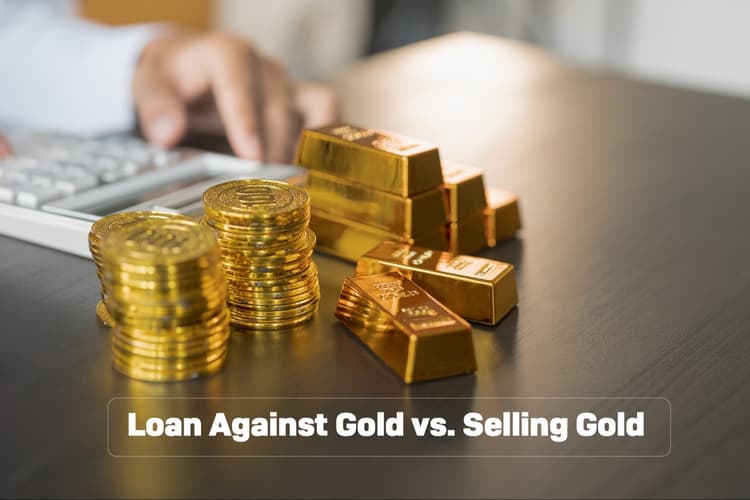
Your gold holdings act as a financial safety net and a sentimental collection of memories during economic instability. Deciding whether to sell gold directly or take a loan against gold in India to get cash during the uncertain financial situation in 2025 has become more difficult and important than ever.
In many cultures and households, gold is valued for more than just money. It serves as both an investment and a symbol of cultural heritage, with families in India, the Middle East, and elsewhere collecting gold jewelry, coins, and bars over generations. This long-standing tradition turns what might be a simple financial decision into a complex balance between practical needs and emotional significance.
The importance of gold is even greater in 2025 compared to previous years, as gold prices have soared to previously unseen levels. In May 2025, gold surpassed $3,300 per ounce and is expected to go over $4,000 by mid-2026. This price increase has been driven by continuous central bank purchases, inflation, and geopolitical uncertainties, making your gold holdings more valuable than you might have initially thought.
Based on data from the Reserve Bank of India, gold-backed lending in India has risen by 103% in recent years, showing a significant increase in gold loans. Many benefits make gold loans attractive to those needing short-term funds.
When you opt for a gold loan, you transfer ownership of your gold but use it as security for quick cash. If you repay the loan fully, you might be able to recover your gold. Compared to unsecured loans like credit cards or personal loans, lenders typically offer 60-75% of your gold's current market value with attractive interest rates.
There’s also an emotional benefit that heirlooms and sentimental items can provide, as they can provide financial support while staying in the family. Digital platforms offered by reliable lenders like Indel Money have made the process more efficient, and these lenders now also offer doorstep services, quick approval, and minimal paperwork.
Even if gold has a strong emotional connection, there are situations in which selling is the better choice. This is a strategic financial move to maximize profits by selling gold assets, especially during the record-high prices of 2025. This is particularly true for unused or emotionally insignificant gold items.
Selling gold provides immediate cash, free from interest or future repayment obligations. For individuals with high-interest debts, such as credit card debt often exceeding 20% APR, paying off these debts can be more advantageous than waiting for gold to appreciate in value.
Selling the gold also offers psychological relief that allows people to regain financial clarity while redirecting funds into more productive investments like real estate, starting a business, or for educational needs - all without concerns about unpaid debts. At the same time, certain types of gold, like coins or bullion bars, typically sell for higher prices than jewelry, which may incur manufacturing costs and have lower purity requirements.
When choosing a loan or to sell gold in India, consider your specific situation and current market conditions. This could include your urgency for funds, as both options can provide quick access to money. Loans follow a structured repayment process while sales usually involve an immediate final payment.
In today's unpredictable gold market, timing is more crucial than ever. Factors like central bank policies, inflation, and geopolitical issues influence prices. Monitoring market trends on trustworthy platforms can help you identify the best times to buy or sell. The value of gold usually drops when the US dollar is strong, which is another important factor to keep in mind.
Emotional attachment to jewelry or bullion should also be considered. Damaged jewelry or non-sentimental gold may be better sold, but family treasures or items with emotional value might be worth taking a loan against to keep them safe.
Financial discipline is essential. Repaying gold loans consistently is necessary, as defaulting could lead to losing your collateral. This risk is similar to selling the gold, but with additional interest costs over time.
As technology has progressed, the environment for gold loans has changed a lot. With digital paperwork, quick payouts, and online applications, lenders who offer a Gold loan in India have made borrowing easier.
In a field that has often lacked transparency, the digital revolution has made things clearer. Trustworthy gold loan providers now give detailed explanations of repayment schedules, purity checks, and valuation methods. No matter which method they choose, this transparency helps customers make informed decisions.
Cultural views on owning gold often influence whether people prefer to loan or sell it. In India, where families hold about 11% of the world's gold, there is a strong emotional attachment to gold, making loans attractive even if the terms are not always favorable.
There are also cultural differences among people across the world that show how social and emotional factors are closely related to financial decisions. Personal situations, cultural beliefs, and how people see gold as an investment all affect the best choice.
There is no universal solution to choosing between a loan and a sale. The best option for anyone depends on their personal financial situation, emotional attachments, and market timing. Generally, gold loans are more suitable for short-term cash needs with consistent repayment ability, while selling often proves better for long-term financial restructuring or managing high-interest debt.
In today's financial climate, many find that a gold loan is the smarter choice. It allows you to leverage your gold's current high value without losing ownership. Gold loan preserves your gold's potential for the future and maintains its sentimental value, all while providing necessary cash for urgent needs. It helps you address a short-term financial gap without sacrificing long-term assets. A gold loan exemplifies smart, forward-thinking wealth management because it offers transparent terms, low interest rates, and the security that your family's treasures are safe once repaid. It respects both your emotional connection and your financial needs.

When people are in pursuit of budget friendly ways to get a loan, their eyes usually lock onto a standalone metric, the interest rate. Even though a low headline rate is important, it is only one part of the equation. True economic affordability and accessibility has many layers that have to be taken into account such as hidden costs, structural soundness and sustainability, the length of the tenure, and how the financing product aligns with your actual cash flow. As a matter of fact, a loan that looks cheap on the surface can actually become a heavy burden if tight terms or unexpected penalty clauses are thrown at you during the middle of the tenure.
In this blog, Indel Money, the most well known, recognized and reputable loan company in India gives a deep insight into what makes a loan truly accessible and affordable.
Loan affordability is about minimizing the actual cost of liability based financing while avoiding mental strain and protecting your peace of mind. Widely recognized non-banking financial companies (NBFCs) like Indel Money have completely transformed and redefined the debt capital ecosystem by coming up with capital products that evaluate loan performance from origination to maturity, therefore, making sure that borrowing lays the foundation and opens doors for better prospects, instead of becoming a financial quagmire.
In order to analyze if a loan company in India or credit facility is truly easy on the pocket you must comprehensively evaluate the basic marketing figures of the past. True economic affordability is structured on the foundation of four core pillars:
Transparent Pricing: Zero undisclosed service charges, administrative costs or hidden clauses.
Customized Tenures: Aligning the repayment schedule to your monthly revenue cycle,instead of mandating a “one-size fits-all” timeline.
Collateral Optimization: Exalting the loan-to-value ratio (LTV) allows you to access the right amount of funds from existing assets and holdings without excessive borrowing.
Frictionless Prepayment: Allowing borrowers to satisfy their monetary obligations and retire their debts before the completion of the loan tenure without facing punitive assessments.
When these components come together borrowers can successfully avert the chain reaction of supplemental expenses that usually amplify financial liabilities
In the vast and extensive domain of Non-Banking-Financial-Companies (NBFCs) and loan companies in India, Indel Money stands apart and shines above the rest. The company has distinguished itself by curating its signature services around these fundamental pillars of holistic financial access. Instead of coercing and compelling customers with run-of-the-mill financing packages, the institution prioritizes focusing on collateral based borrowing, predominantly gold loans, which intrinsically minimize risk and significantly de-escalate debt services expenses when compared to conventional unsecured personal loans in India.
By providing customers with competitive, market-leading interest rates, Indel Money makes sure that a sizable chunk of your periodic cash flows is directly channeled into the process of principal repayment, rather than just servicing the accumulating interest. Moreover, our unwavering commitment to transparent compliance reporting and unambiguous disclosures mean that customers will not be subjected to unexpected bureaucratic surprises at the eleventh hour.

Micro, Small and Medium enterprises are essentially the core lifeline of the modern economic landscape. As these businesses expand operations and broaden their organizational footprint. New capital infusions are periodically required. Securing and leveraging capital from seasoned institutional investors or specialized Non-Banking Financial Companies (NBFCs) comprises a comprehensive evaluation of multiple operational and financial performance markers. Lenders usually assess certain risk factors and potential liabilities to calculate creditworthiness. When MSME businesses approach widely recognized financial institutions like Indel Money, specific criterias are examined to make sure capital is put to use effectively and efficiently.
In this, Indel Money, one of the most popular Non-Banking Financial Companies (NBFC) in India, gives a deep insight into what lenders are looking for before offering an MSME loan in India to growing micro, small and medium sized businesses
The central priority during any credit evaluation is given to the financial statements and capital moving reports of any business organization. Regular streams of revenue, return on sales, and past balance sheets are rigorously examined by professional credit analysts. For attaining an MSME loan in India, lenders require proof that the business makes enough money to fuel their operating costs while seamlessly taking care of outstanding debts and liabilities. For growing micro, small and medium sized businesses it is important to maintain meticulously audited and verified financial records and statements, because the transparency of these documents minimize the perceived risk of failure and fastrack loan approvals.
Historical credit utilization of both the company and its promoters will be subjected to intense scrutiny. Credit bureaus will be put on the job to analyze credit scores, current debts, and prior covenant breaches. A flawless credit history indicates strong credibility and robust financial discipline. Lenders and financial institutions usually prefer businesses that showcase a well balanced debt-to-equity ratio. When transparent credit monitoring and debt surveillance is put in place, financial institutions will feel a lost less apprehensive and more secure in offering high credit limits to foster future expansion goals
Beyond the balance sheet, the commercial viability and the scalability of the business model will be analyzed comprehensively. Credit examiners evaluate the core strength of the business, the customers they are catering too, and popular industry trends. Businesses that operate in recession resistant markets with a clear line of sight on growth and strategic growth trajectories are viewed through a positive lens. Lenders want to certain that the funding provided will be employed for growth and productivity purposes only such as material sourcing and acquisition, upgrading infrastructure or operating cash flow expansion.