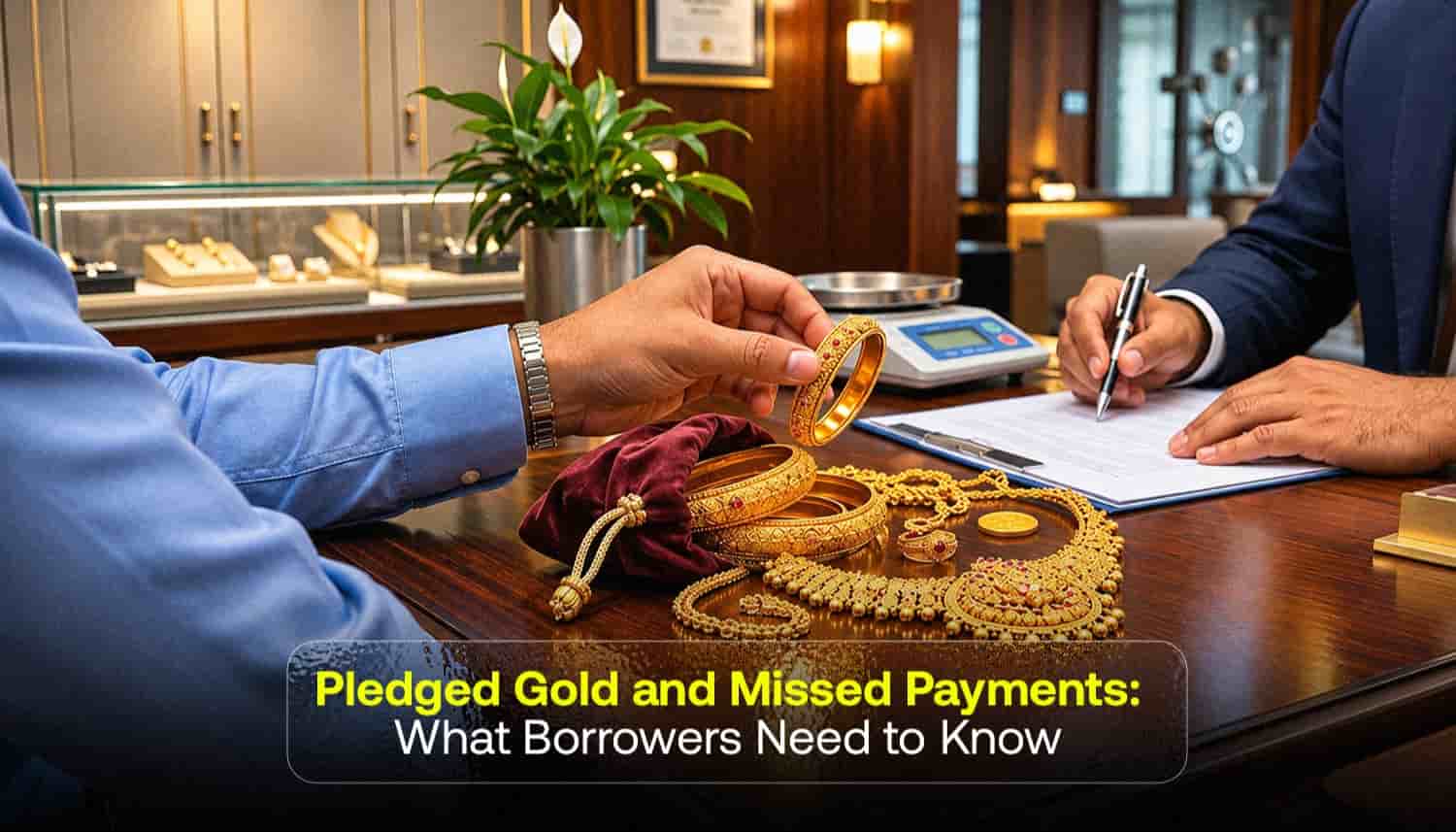




If you have gold sitting at home, a digital gold loan lets you access its value instantly by completing most of the process online.
Digital gold loans in India have made borrowing against your jewelry faster and far less complicated than it used to be.
You don't fill out lengthy forms. You don't wait weeks for approval. You visit a branch once, pledge your gold, and after that, almost everything else, payments, top-ups, balance checks can be done from your phone.
What is a digital gold loan? A digital gold loan is a secured loan where you pledge your physical gold jewelry at a branch and manage the loan digitally after that. You receive money on the spot, pay interest or make payments online, and recover your gold when you pay off the loan.
Important to know: As per current RBI guidelines, you have to pledge new gold loans in person at a branch; however, once the loan is active, you can pay interest, repay the principal, and request top-ups anytime through your app. It’s a phygital process with one branch visit and all digital thereafter. |
A traditional gold loan required you to visit a branch for everything. Applying, paying, checking your balance, renewing. Every step meant a trip.
A digital gold loan keeps the first step at the branch, because that's where your gold gets assessed. But everything after that is online. You can pay from your phone at midnight. You can check your outstanding amount anytime. You can apply for a top-up without leaving your house.
That shift makes a real difference, especially for people who need quick liquidity but don't want to take multiple days off for bank visits.
It offers several clear advantages, making it one of the most practical borrowing options in India today.
It only takes a very short time to receive the funds from a loan after a gold appraisal and KYC process are done. This helps people facing financial constraints.
Gold loans are secured loans. Your gold is the collateral. So your CIBIL score doesn't determine whether you qualify. This makes it accessible to a much wider group of borrowers, including first-time borrowers, self-employed individuals, and those with limited credit history.
Since a gold loan is backed by gold as an asset, lenders can offer lower interest rates when compared to unsecured personal loans.
This makes it a cost-effective option when you need funds for a short- to medium-term.
You can repay the principal at the end of the tenure and pay only interest in between. Or you can pay both together. Or make part payments whenever you have the funds. The online access makes this easy to manage on your own schedule.
A valid ID and Aadhaar are usually enough. There's no income proof requirement for most gold loans, especially for smaller amounts, as per current RBI gold loan guidelines.
The gold you pledge is stored securely at the branch for the entire loan tenure. It's insured and returned to you in full once the loan is repaid.
The process is straightforward. Here's how it works at Indel Money:
Step | Process |
Visit the branch | Bring your gold jewelry and valid ID to your nearest Indel Money branch. |
Gold assessment | Staff checks the purity and weight of your gold on the spot. |
Loan offer | You're shown the loan amount you're eligible for. |
Documentation | Quick KYC verification with Aadhaar and PAN |
Disbursement | Amount transferred to your bank account, often the same day |
Online access | Use the app to pay interest, repay principal, or top up anytime |
The branch visit is short. Assessment and documentation together typically take under an hour. After that, your loan account is active and accessible online.
Eligibility is simple. Most people who own gold jewelry qualify.
Age: 18 years and above
Gold type: Jewelry and ornaments between 18 and 22 karat purity
Documents needed: Aadhaar card, PAN card, and a recent photograph
Gold ownership: The gold must belong to you or an immediate family member with their consent
Note: Gold bars, gold ETFs, and digital holdings of gold are not acceptable as collateral. According to RBI norms, only physical gold jewelry and ornaments are eligible.
The loan value is determined by the purity and weight of the gold along with its current market value. Lenders have to comply with the RBI-mandated maximum LTV for gold loans.
In general, if you apply for a loan of less than ₹2.5 lakh, you can borrow up to 85% of your gold's value. For higher loan amounts, the LTV ratio steps down slightly. Your Indel Money branch executive will calculate the exact amount based on your gold during the assessment.
Once your loan is disbursed, the digital side takes over. With Indel Money's website and mobile app, you can:
Pay monthly interest from your bank account or UPI
Make part payments toward the principal
Apply for a top-up loan if your gold's value allows for additional borrowing
Check your outstanding balance and repayment schedule
Get statements and transaction history
You don't need to visit the branch for any of these. That's the core convenience of a digital gold loan.
Yes, borrowing from a regulated lender helps ensure your safety and fair loan terms. Gold loans are overseen by the Reserve Bank of India. They have specific rules for the evaluation of gold, gold storage, how much information is shared, and how the lender is to collect any funds in the event of default.
At Indel Money, your gold is stored in secured vaults with full insurance cover for the duration of the loan. It's returned to you in the same condition once repayment is complete.
Always check that your lender is registered and regulated. Indel Money is an RBI-registered NBFC, operating under all applicable guidelines.
Indel Money is one of the best gold loan companies in India, with expertise in lending gold loans in a hassle-free and swift manner.
What makes Indel Money unique is its quick, easy service. The disbursement is same-day. Then your account will be fully accessible online, so you don't have to visit again.
A team that understands the needs of gold loan borrowers across India and is here to help you get an instant gold loan online with low interest rates and flexible repayment options.
If you have gold jewelry and require money, visit the nearest Indel Money branch to get started.
A digital gold loan is a loan secured by physical gold jewelry, managed mostly online.
Under RBI rules, you must submit freshly pledged documents at a branch. Once the money is disbursed, all things are digital.
The advantages include quick disbursement, no credit rating needed, lower interest rates, and flexible settlement.
To be eligible, you need to be 18+ years of age, have valid KYC documents, and own physical jewelry ranging from 18–22 karat gold. The current RBI norms exclude gold bars, ETFs, and digital gold from being accepted as collateral.
Once your loan is active, you can make payments, pay interest, and manage your loan account all from your mobile phone.
Sources: Reserve Bank of India | RBI Master Directions on Gold Loans
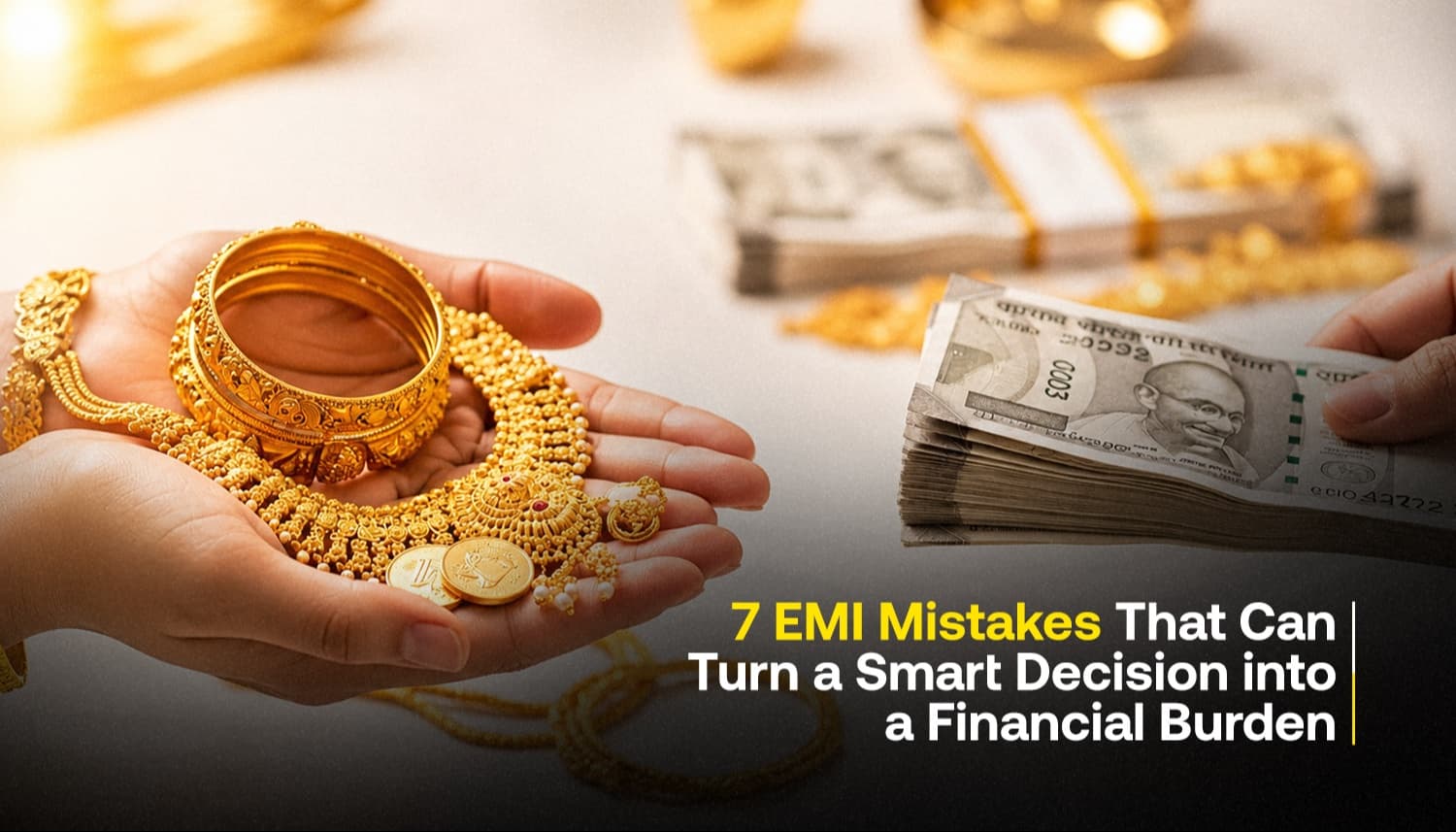
EMIs are the best way to make big loans feel easy. But this easy solution can become a headache if you don't have a clear financial plan.
Lakhs of people across India take gold loans every day for big purchases or emergency spending. The monthly installment feels manageable, but somewhere along the way, small mistakes turn this into a financial nightmare.
The good news is that these mistakes are entirely avoidable.
This is the most common one. A lender shows you a monthly installment that seems affordable, and you say yes.
But the EMI is just one number. What actually matters is the total amount you'll pay over the full tenure. Including the principal, interest, and processing fees.
A loan of ₹50,000 for two years with an interest rate of 18% costs more than a shorter loan period. When you choose to pay a lower EMI, you end up paying a lot more in the long run.
Always check the total amount that needs to be paid before opting for an EMI, as the monthly payments do not represent the total cost of the purchase.
If you think stretching your tenure to make the monthly EMI easy, you are wrong. In most cases, it isn't worth it.
As the tenure extends, you will have to pay more interest. Even at the same interest rate, a 3-year tenure costs significantly more than a 1-year tenure.
If you can, choose the shortest tenure you can manage based on your income.
One missed payment feels minor. The consequences aren't.
Missing an EMI directly hits your CIBIL credit score. When your credit score takes a hit, it becomes harder for you to secure future loans. You might also get burdened with higher interest rates because lenders may see you as a high-risk borrower.
On top of that, banks charge late payment penalties, and your outstanding balance can increase significantly.
Set up an auto-debit instruction from your bank account. Schedule it for the day after your salary credit. That one step removes the risk entirely.
This one is small but surprisingly common.
If your monthly paycheck hits your account after your EMI auto-debit, your account may have insufficient funds. As a result, your EMI payment will be considered missed, and your account may be charged a late payment penalty, bank charges, and a missed payment fee.
When you take a loan, choose an EMI date 3 to 5 days after your salary credit date. That buffer matters.
Many borrowers focus entirely on the interest rate and ignore everything else in the loan agreement.
But lenders can charge fees like processing fees, prepayment penalties, foreclosure charges, and bounce charges for failed auto-debits. These can add up to a meaningful amount over the loan tenure.
Before signing anything, ask for a complete breakdown of all charges. A regulated loan company in India will provide this upfront and clearly.
A single EMI is manageable. Three or four running simultaneously is where people run into trouble.
Financial planners generally recommend keeping your total EMI outgo below 40% of your monthly income. So if you earn ₹40,000 a month, your total EMIs across all loans should ideally stay under ₹16,000.
Many finance companies in India make it easy to split purchases into installments. That's convenient, but it adds up fast. A phone on EMI, a TV on EMI, and a personal loan EMI can quietly eat up most of your monthly income before you've paid rent or groceries.
Before taking a new loan, add up what you're already paying each month. Make sure there's room for the new EMI and your other expenses.
If you come into extra money, paying off part of your loan early is one of the smartest things you can do.
Prepayment reduces your outstanding principal. That means less interest is calculated on the remaining balance, and you can either lower your EMI or shorten the remaining tenure. Both outcomes save you money.
Some lenders charge a prepayment fee. Be sure to review this before you sign the loan agreement. There are several gold loan nbfc in India that charge little or no prepayment fee, and it is important to shop around before finalising the terms of your gold loan.
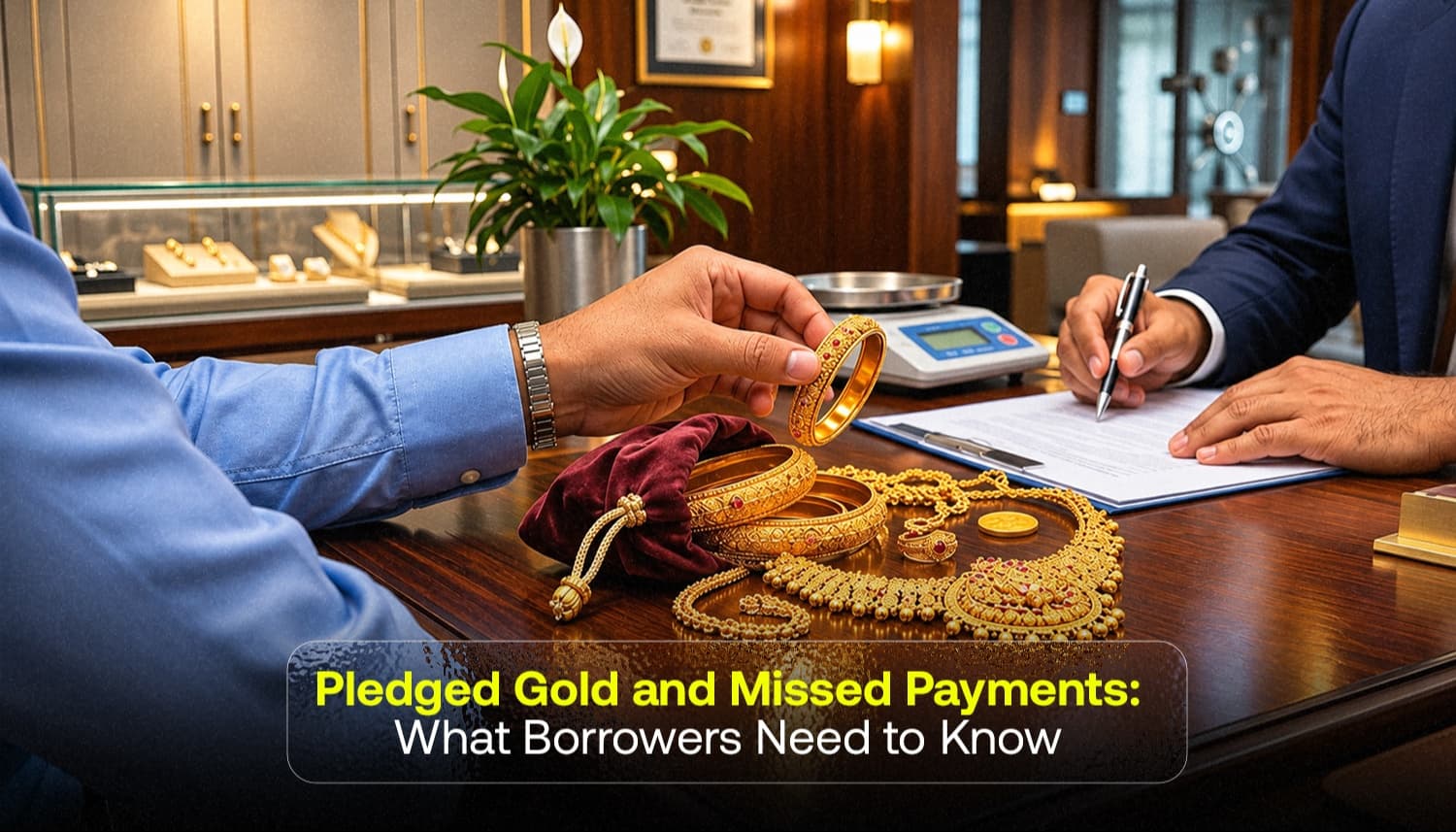
Missing a gold loan payment is stressful. But it doesn't mean you've lost your gold.
Gold loans in India are one of the easiest ways to get credit. You give your jewelry, get money promptly, and repay it over a set period.
Fortunately, the Reserve Bank of India has set rules to protect you at every step. The lender can't just take your pledged gold without proper notice and process.
In case you default on the gold loan, the lender will call you up and remind you to pay. Your lender will only put your gold up for auction after your account becomes a Non-Performing Asset (NPA) after 90 days of non-payment. Even so, they must give advance notice before any auction, and they'll return any surplus from the sale to you. |
One missed payment won’t trigger an auction.
Your lender will typically contact you by phone, SMS, or mail if you miss an EMI. A late payment fee and extra interest starting on the default date will be applied to late payments. Your credit score could also suffer if the lender reports the missed payment to a credit bureau.
Auction arises only if the account remains unpaid for over 90 days. If you don't repay the loan by then, it becomes a Non-Performing Asset (NPA).
So if you've missed one payment, the priority is simple: contact your lender immediately. Most trusted gold loan providers will work with you on a repayment plan before things escalate.
A lender can only auction pledged gold after following a regulated process defined by the RBI. The Reserve Bank of India has laid down guidelines that no auction can occur without proper notice to the borrower.
The process is usually as follows:
Once your account is classified as an NPA, the lender issues a formal demand notice.
The lender announces the auction in advance, stating the date, time, and outstanding amount.
This notice should give you a final chance to repay and recover your gold.
The minimum reserve price is 90% of the market price (if the auction is to be held).
Any auction proceeds that exceed the loan amount, interest, and charges will be returned to you within 7 working days.
Your gold remains your property until the auction is legally completed. Lenders cannot sell it quietly or without following this process.
The RBI has tightened gold loan regulations significantly to protect borrowers. These rules apply to all banks and gold loan NBFCs in India.
Key changes that affect borrowers include:
Loan-to-Value (LTV) ratios are now tiered. The lender can provide up to an 85% loan for gold loans of Rs 2.5 lakh and below. For loans ranging from Rs 2.5 lakh to Rs 5 lakh, the limit is 80%. For loans exceeding Rs 5 lakh, the limit is 75%.
To value gold, use the average price of 22-carat gold over the last 30 working days, as quoted by the India Bullion and Jewelers Association. This prevents arbitrary overvaluation.
Lenders should return the gold within 7 days of loan closure.
The valuation procedures, terms, and auction rules should be specified in detail in the contract in the borrower's language.
The rules are applicable to both bank loans and gold loans from NBFCs in India. As reported by Business Standard, the RBI introduced these tighter norms to bring more discipline and transparency to the sector.
There are more options than most borrowers realise.
The key is to act early! Let your lender know you may struggle to make your payment. RBI-regulated, trusted lenders can help people in temporary difficulty.
The following are some options that can be considered:
Partial payment: To prevent escalation and show good faith, partial payments can be made.
Loan restructuring: Trusted lenders may allow you to restructure the payment terms if your financial conditions are not favorable.
Interest-only payment: Interest-only payments can be made for some gold loans before starting to pay the principal.
Gold top-up/re-pledge: If the value of your gold has risen, you may be able to restructure the borrowing terms to allow longer grace periods.
The one element that always exacerbates the issue is waiting and hoping it will get better on its own. Missed payments compound and interest accumulates. And the window to act before an auction narrows.